
THE LITTLE LUMP THAT TRAVELED THE WORLD - History of Hash.

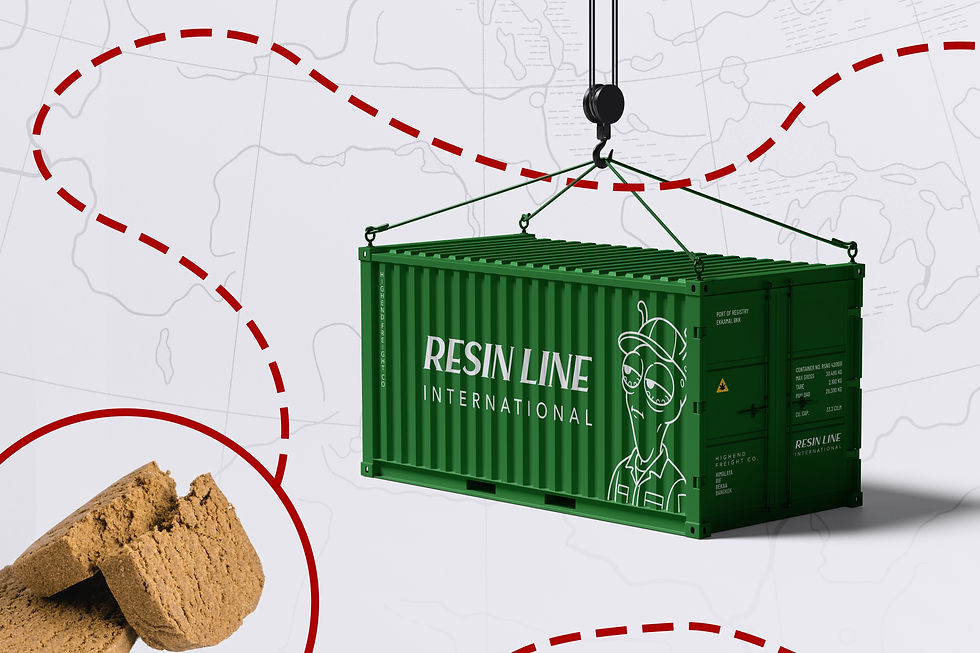
Hash, hashish, hasj, charas, bhang: the history of hash is a very long trip from ancient cannabis culture to your grinder.
There is something funny about hash. A cannabis flower looks like a plant. Hash looks like someone took the best part of that plant, squeezed it into a little brown lump, and said, "Yeah, that's enough." And somehow, people have been doing some version of this for a very, very long time. Long before strains had names. Long before anyone was arguing about THC percentages. Long before there was a dispensary menu with seventeen different kinds of Gelato on it.
People were already figuring out how to collect the resin from cannabis and turn it into something else. That little idea ended up traveling across mountains, deserts, trade routes and entire continents. And eventually, it made its way to Thailand too.
So let's follow it.
First, the Good Stuff (What Hash Actually Is)
If you've ever looked closely at a really frosty cannabis flower, you've seen the tiny crystals covering it. Those are trichomes. They are the little resin factories of the cannabis plant, producing much of the THC, CBD and aromatic compounds that make different cannabis varieties smell and feel the way they do.

Hash, also called hashish, is basically those resin glands collected and concentrated into their own thing. It is what happens when you decide the best part of the plant deserves its own category. Instead of smoking the flower as it is, the resin is collected and concentrated into a separate product.
The result can be dry and crumbly. Soft and oily. Dark. Golden. Sandy. Sticky. Some hash practically melts when heated. Some behaves like a little piece of chocolate.
And if you've spent enough time around cannabis, you eventually learn that two pieces of hash can look almost identical and smell completely different. That's where things start getting interesting. Because there isn't really one hash. There are hundreds of traditions.
Charas, Bhang and the Old-School Cannabis World
Go far enough back into cannabis history and you start running into three words: Ganja. Bhang. Charas. They all belong to the same plant, but they are not the same thing.
Ganja traditionally refers to the flowering tops. Bhang is generally a preparation made from cannabis leaves and is traditionally consumed as a drink or food. Charas is cannabis resin.
That last one is particularly important. Charas became deeply associated with cannabis culture across parts of the Indian subcontinent and the Himalayas. And cannabis itself was not simply treated as something you smoked when you wanted to get high. It had a place in traditional medicine, food, religious practice and festivals.
Bhang, for example, became closely associated with religious traditions and celebrations in India. So the idea of putting cannabis into a drink and making a day of it is considerably older than your local infused soda. By a lot.
In the history of Hash, hash did not have One Birthday
This is the part where cannabis history gets much more interesting than the usual "hash was invented in 900 BC" type of internet fact. We don't have one neat date. There was no ancient guy named Greg who woke up one morning and invented hash.
The cannabis plant has been used by humans for thousands of years, and archaeological evidence shows cannabis was used in Central Asia in ritual contexts more than 2,500 years ago. But the development of cannabis resin products happened through different cultures and over long periods of time.
Instead of one birthplace, think of hash as having a family tree. Different places figured out different ways to collect the resin. Different communities developed their own traditions. And as people moved, traded and traveled, those traditions moved with them. That is how you end up with hash cultures that can look completely different from one another.

From Mountains to Markets: The Famous Hash Regions
For centuries, cannabis and cannabis resin circulated through parts of South Asia, the Middle East and North Africa. Then particular regions became famous for their own styles.
India and Nepal: charas and traditional hand-collected resin.
Afghanistan: famous for traditional dark, soft hash.
Lebanon: a major hash-producing region, particularly during the 20th century.
Morocco: one of the biggest names in the global hash world, especially through dry-sift production in the Rif.
Morocco's modern hash industry is particularly interesting because the technique itself was not necessarily ancient Moroccan tradition in the form we imagine today. Research indicates that the sieving method used for hash production arrived in Morocco around the 1960s, likely from Lebanon, and the country's export industry grew rapidly from there.
So even hash has a history of borrowing ideas. Someone figures something out. Someone else sees it. Someone makes it their own. And eventually the whole world knows the name.
And Then Hash Got a New Life in Europe
By the 20th century, hash had become part of an international underground cannabis culture. Europe became a major destination for Moroccan and Lebanese hash, especially from the 1960s and 70s onward.
This is where a lot of modern cannabis culture starts to feel familiar. Hash in a cigarette. Hash mixed with flower. A little piece being warmed between fingers. A brick wrapped in something that definitely did not come with a laboratory certificate.
The classic European hash experience was not necessarily about fancy extraction. It was about having something compact, potent and easy to move around. And if you've ever heard an older smoker talk about "the good old Moroccan stuff," now you know what they're talking about.

Then Thailand Entered the Story
Thailand's cannabis history is its own rabbit hole. Cannabis had already been used traditionally in Thailand, including in food and traditional medicine. But Thailand's place in global cannabis culture became much bigger during the Vietnam War era.
And interestingly, it wasn't hash that made Thailand famous. It was flower. Thai Stick.
The Thai Stick Years
During the 1960s and 70s, Thai cannabis became highly sought after by American consumers. High-grade Thai and Laotian cannabis was being exported into the American underground market, where it commanded premium prices.
Thai Stick became legendary. The name referred to a traditional presentation of Thai cannabis buds arranged around small sticks. To American consumers at the time, it was exotic, rare and seriously good weed coming from the other side of the world.
Thailand had become part of the global cannabis imagination. And the funny thing is that this happened decades before Bangkok would have a dispensary on practically every other street. The plant had already built the reputation. The dispensaries came later.

So Where Does Thai Hash Fit?
This is where we need to be honest. Thailand has a fascinating cannabis history. Thailand has traditional cannabis use. Thailand has Thai Stick. Thailand now has a modern cannabis industry.
But it would be misleading to put Thailand on the same historical hash map as Morocco, Afghanistan or the Himalayan charas traditions and pretend it has an ancient hash culture of equal importance. The Thai story is different. And that's exactly what makes it interesting.
Thailand's cannabis identity was built around the plant itself, traditional uses and eventually some of the world's most famous cannabis flower. Then the modern global cannabis movement came back around. And suddenly Thailand found itself sitting in the middle of the conversation again.

Why Do People Love Hash?
At this point, you could give the scientific answer. It's concentrated cannabis resin. It contains cannabinoids and terpenes. It can be more potent than ordinary flower. All true.
But that's not really why people get excited about hash. Ask someone who actually loves hash and they'll probably start talking about the smell. Or the texture. Or how it bubbles when heated. Or whether it melts properly. Or the first time they had really good dry sift. Or some piece of old-school hash they still remember years later.
That's the thing about hash. It has personality. Flower can be beautiful, but hash makes you interact with the cannabis differently.
You pick it up. You break it. You smell it. You look at it. You wonder where it came from. And then somebody inevitably says: "Wait. Smell this."
The Hash You Know Is Not the Hash Your Friend Knows
This is where we could spend another thousand words. But we're not going to. Not today.
Because once you start looking into modern hash culture, the rabbit hole gets very deep very quickly. Dry sift. Ice water hash. Rosin. Full melt. Temple balls. Different grades. Different textures. Different ways of preserving the plant's aroma. Old-school techniques meeting modern technology. And the eternal question: why does this tiny jar cost so much?
That's the fun part. Because hash has gone from something people made with very simple methods to one of the most obsessive corners of modern cannabis culture. And that deserves its own story.
The Little Lump That Kept Going

From charas in the Himalayas to Moroccan hash. From bhang in India to Thai Stick in Thailand. From hand-collected resin to modern full-melt.
The technology changed. The cultures changed. The names changed. But the basic idea stayed remarkably simple: find the resin, keep the good stuff.
Thousands of years later, we're still fascinated by it. And honestly? We still love it:)
Next Time at Highend
Inside the world of modern hash. What actually separates dry sift from ice water hash? Why does some hash melt and some barely move? What does "full melt" actually mean? And why are people staring at a tiny jar of golden resin like they've just discovered the Holy Grail?
We'll get into all of that next. That's a story for another smoke. A Few Quick Questions:
What is hash?
Hash, or hashish, is concentrated cannabis resin. You collect the trichomes off the flower and press them into their own thing.Hash, or hashish, is concentrated cannabis resin. You collect the trichomes off the flower and press them into their own thing.
Is hash stronger than regular flower?
Usually, yes. It is more concentrated, so gram for gram it tends to hit harder.
Where does hash come from?
No single place. Charas in the Himalayas, hash in Afghanistan, Lebanon and Morocco, and plenty of stops in between.


Comments